Monday, September 3, 2012
The safest car
There are a lot of things to consider when buying a new car, such as its engine size, boot capacity, fuel type, and a whole host of other factors which might affect drivability and car insurance cost.
 However, one thing some people might forget about when purchasing a new vehicle – whether it’s second-hand or fresh off the forecourt – is its safety score.
Well, for people worried about the safety of their car, there’s one vehicle they can rely on to keep them very, very safe indeed.
That, according to the Euro NCAP tests, is the Volvo V40.
Reportedly, this vehicle achieved the highest ever recorded score. It was tested on adult and child occupant protection, safety assist, and pedestrian protection, and excelled in all!
The car is available at a starting price of £19,745. I’m going to start saving up!
Photo © NRMA New Cars via Flickr, under Creative Commons Licence
Labels: boot capacity, car, car insurance, cost, drivability, engine, Euro NCAP, forecourt, fuel, new, protection, safety, safety assist, second-hand, test, vehicle, Volvo V40

Tuesday, August 28, 2012
App for avoiding a red light
Fed up of being caught by red lights?
 Not only is it frustrating getting stuck behind a red – sometimes for several lights in a row – but stopping and starting all the time is uneconomical when it comes to fuel and can cause car wear and tear.
 A group of researchers in Massachusetts Institute of Technology, USA, are trying to solve this problem, and have come up with a clever mobile phone app.
It’s still being tested at the moment, and there are no reports as to whether it would eventually be released for sale in the UK, but here’s how it works.
Mounting a phone on a vehicle’s dashboard allows the device to take photos of any traffic lights being approached by car.
By sending several photos of the lights to a computer, which analyses the information, the mobile phone then receives an estimated speed at which the motorist should drive to avoid having to stop at a red light.
To avoid the road user having to pick up the handset, the information is not sent via text. Instead, one quick glance at the phone’s screen, without any need to remove it from its mount on the dash, should tell the driver what they need to know.
One would imagine that the app will not encourage motorists to speed in order to avoid the red. It is likely the app will signal that the driver should slow the car so by the time they reach the lights they have turned green again.
I’m guessing that there will also be a message on the screen at times which states something along the lines of ‘sorry – there’s no way you can miss this one – so don’t even try’.
Labels: app, car, dashboard, fuel, Massachusetts Institute of Technology, mobile phone, red light, speed, traffic light
Monday, August 13, 2012
A purposeless road trip
“Are we there yet?”
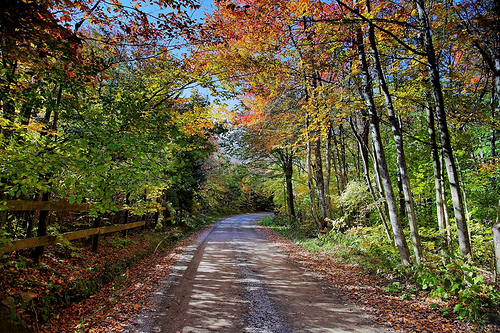
Apparently, in many cases the answer will be “No” for the duration of the trip.
According to a study by a provider of car insurance and Populus, out of more than 20,000 motorists, 55% have gone for a drive – just to have a drive.
Getting behind the wheel solely to commune with the road is not uncommon – 10% of the people surveyed did it every week.
I’ll have to admit, I’ve never got into my car when I didn’t have a destination in mind. For one thing, I wouldn’t know where to go, and for another thing, fuel is too expensive to be driving without a goal.
Yet, ignoring the expense of filling up the tank, I think having a lack of scenic routes has a big part to play in my lack of aimless motoring.
I believe my point is proven by the statistics. In Northern Ireland, Scotland and North East England, more than 60% of people have just gone for a drive – whereas only 47% of Londoners have bothered taking such a purposeless trip.
I know that driving past impressive natural scenery would be much more likely to get me into my car than pavements and office blocks. Still, I suppose not having a green and pleasant land on my doorstep is saving me money.
Labels: car insurance, destination, drive, driving, fuel, motorist, Populus, route, trip, wheel
Monday, April 16, 2012
Family find a unique way of beating fuel duty
The British public have come up with a variety of ways of keeping fuel expenses to a minimum. Some have chosen to drive less. Others have filled their tanks up with whisky (not advisable). However, few would have been prepared to trade their trusty vehicles in for a horse and cart.
 A family from Essex have bucked the trend by calling their white and grey Lipizzaner horses into action. They claim that the chosen method of transport for people in the nineteenth and even early twentieth centuries still has a place in today's technologically focused society.
Apparently they are far more reliable than both the Kia Sportage and the Nissan Micra to name a couple. They are also reported to offer a more pleasurable off-road experience than the typical 4X4.
One of the horse owners said, “The price of fuel these days is extortionate – it wasn’t that long ago I could put £20 in the Land Rover and it would fill it up to a quarter of a tank, but now it won’t even stop my fuel warning light.
“The horses need feeding and exercising anyway so it just makes sense. In the current economic climate it’s also very expensive keeping horses – but now they are definitely earning their keep.”
Of course the one major downside to travelling by horse and cart is the time that longer journeys can take. With an average speed of around 4mph, a trip between the UK's major cities could take days. However, for leisurely countryside trips there's nothing to beat good old fashioned horse power.
Labels: drive, Essex, fuel, horse and cart, Kia Sportage, Land Rover, Lipizzaner, Nissan Micra, off-road, transport, vehicles
Monday, January 16, 2012
IAM fight for hard-up youths
I can remember the thrill of being told that I'd passed my driving test. The stress-inducing lessons were over and I could look forward to cruising the open roads in my Nissan Micra.
 It wasn't long until reality set in and motoring became a drain on my limited finances. After paying for the young persons car insurance and filling the fuel tank I was left with barely enough for a cheap meal or game of pool with my similarly hard-up friends.
This scenario has become well known amongst the UK's community of young motorists. Indeed, the average cost of insurance for male motorists aged between 17 and 22 has soared to £2,977, far beyond many people's reach.
This issue has become of such concern that the Institute of Advanced Motorists (IAM) have made demands for the government to look into ways of reducing premiums. They claim that youngsters who successfully complete advanced driver training courses should be offered discounts.
The IAM Chief Executive said, “The simplest way to reduce premiums is to prevent accidents. This is especially true for young male drivers who are at most risk of being involved in an accident. We need to start rewarding good drivers by encouraging further training through cheaper insurance”
It will be interesting to see how the government responds to these demands.
Labels: advanced driver training courses, driving test, fuel, IAM, Institute of Advanced Motorists, Nissan Micra, premiums, young persons car insurance
Monday, October 17, 2011
Running on empty
It’s a good thing that cars are so fuel efficient these days – back in our grandparents’ day, it was almost impossible to travel 100 miles without needing to stop at a petrol station, even on a full tank of fuel.
 However, environmental considerations aside, fuel efficiency is becoming a practical necessity.
This is because petrol stations are beginning to disappear from our nation’s roads. Even in my short driving life, just six years, I’ve noticed that petrol stations are becoming increasingly scarce.
More than ever before, I need to plan my fuel stops when making a journey otherwise there’s a very real risk I could be left short and stranded.
Perhaps supermarkets, which offer cheap subsidised fuel are to blame – as other sellers struggle to compete with their prices they shut up shop and disappear.
There are now only 9,000 fuel forecourts in the UK, which is 12,000 fewer than in 1991, and this is despite a doubling in the number of vehicles on the road in the same period.
Cheap car insurance, easy access to fuel, low house prices – our parents and grandparents don’t know how lucky they were.
Labels: cheap car insurance, efficient, fuel, miles, petrol station, roads, tank, vehicles
Monday, April 4, 2011
Used cars – every little helps
When you think “used cars“ your first thought is unlikely to be Tesco.
However, that may all change since the supermarket giant has just launched itself into the second-hand car market and aims to post 3,000 vehicles a week on its site “tescocars.com”.

Customers can search for a car by entering a make, model and specific price bracket, or they can choose to find a car which fits their “lifestyle”. This allows the prospective buyer to enter details such as what they need space in the boot for, how important car comfort or safety features are to them, and which fuel they would rather use.
The buyer also has the opportunity to view a vehicle report, made by the RAC, so they can be sure that the vehicle is in good working order. And, apparently, Clubcard holders will earn themselves 2,000 points if they purchase a car on the company’s site.
So, there you go, Tesco really is adhering to their “every little helps” motto.
Run out of toilet-paper – Tesco. Need sandwiches for lunch – Tesco. Want a used car which fits exactly to your specifications – Tesco.
Labels: eco-friendly, fuel, RAC, used car